Guide
Sub-Zero Freezer Cold, Fridge Warm: What It Means
When a Sub-Zero freezer stays frozen but the refrigerator warms up, the cause is usually a fan, defrost or sensor. Checks to do first and typical costs.
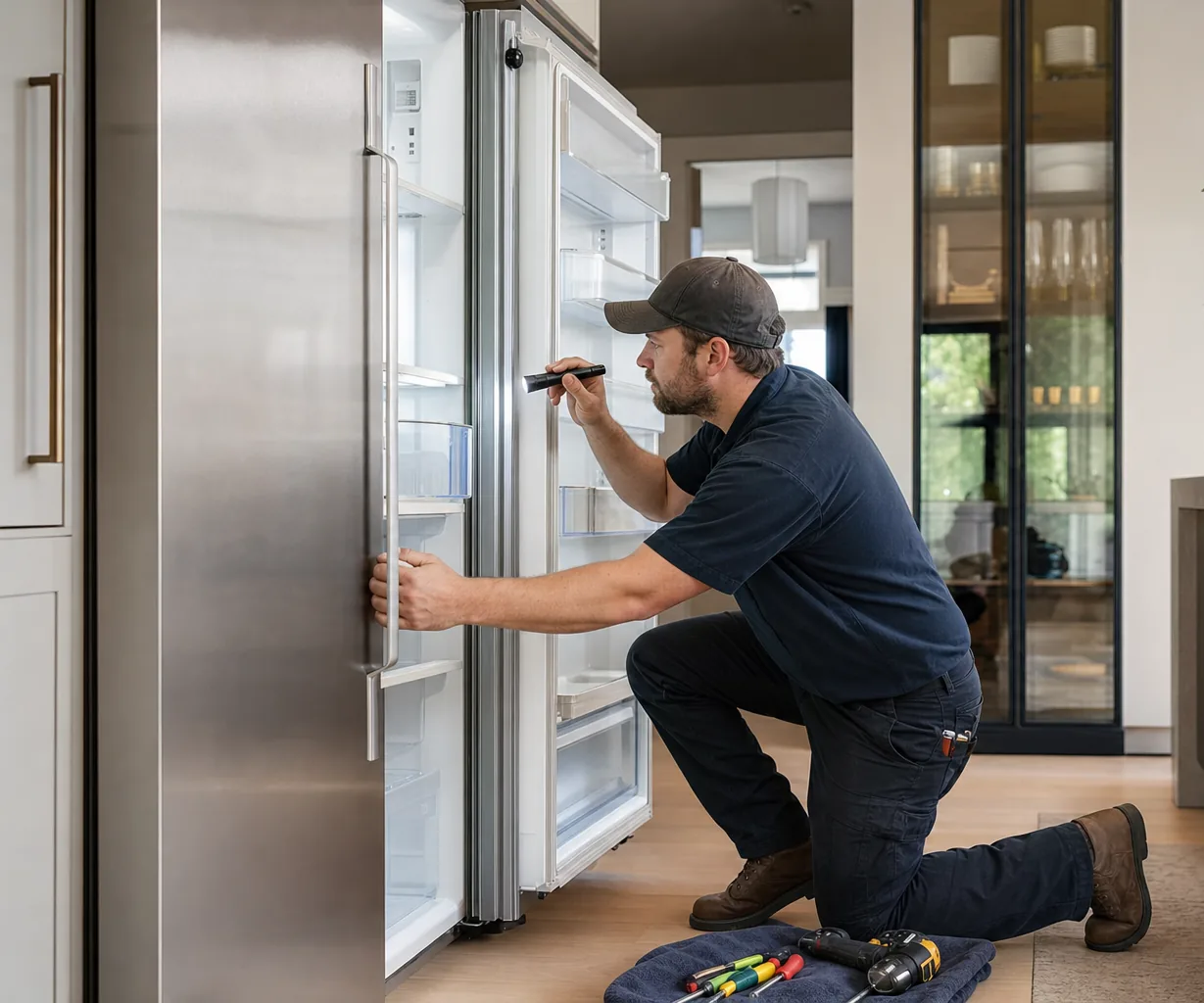
A Sub-Zero whose freezer is still frozen while the refrigerator side climbs past 40°F has a problem on the refrigerator side only, and in most cases it is a part that costs far less than a compressor. Five checks, done in about an hour, tell you whether to clean something or call someone.
Why can one side fail while the other keeps working?
Sub-Zero’s Classic Series uses what it calls Dual Refrigeration: separate refrigerator and freezer systems. Sub-Zero designed it to keep fresh-food odors out of frozen food and ice, and so the fresh-food air keeps its moisture. For troubleshooting, it means the two sides do not share one evaporator and one fan the way many ordinary refrigerators do. A cold freezer proves its own system works; it says nothing about the refrigerator’s fan, defrost or sensor.
PRO Series units go further, with three separate controls for the refrigerator, the refrigerator drawers and the freezer.
Is the refrigerator actually warm?
Measure before you worry. USDA guidance is to put an appliance thermometer in a glass of water in the middle of the refrigerator and read it after 5 to 8 hours. The FDA’s target is 40°F or below for the refrigerator and 0°F for the freezer.
Then look at the setting. Classic (CL) and Designer (DET, DEC) refrigerators come preset at 38°F and adjust from 34°F to 42°F, so a setting nudged up by a family member can explain a slightly warm reading. Allow 24 hours after any change.
Resist turning the control to its coldest point to compensate. The Department of Energy’s Federal Energy Management Program recommends 36°F to 40°F for a refrigerator; a colder setting only makes the system run longer while the real fault stays where it is.
What should you check before calling?
Work through these in order:
- Doors and lights. On Classic (CL) and Designer (DET, DEC) units, a door or drawer left ajar switches the interior lights off to cut heat. If the lights are out, close everything and wait one hour.
- The condenser. It sits behind the flip-up grille on Classic (CL) units and behind the kickplate on Designer (DET, DEC) units. With the unit switched off at the control panel, vacuum it gently with a soft brush. Sub-Zero says a unit less than 6 months old does not need this.
- Messages on the display. A flashing Vacuum Condenser message points to a dirty condenser, a door seal or a unit problem. On 600, 648PRO and 700 Series panels, EC50 with Service flashing means the refrigerator compressor has been running too long.
- How warm it is. Sub-Zero says a refrigerator above 48°F while set at 38°F is unlikely to recover from a condenser cleaning alone. At that point, schedule service.
- The food. The USDA’s power-outage guidance gives a closed refrigerator up to 4 hours before perishable food such as meat, fish, eggs and leftovers should be discarded. If yours has been warm for longer than that, err on the side of throwing them out.
Which parts usually cause it?
| Likely cause | What you may notice | Typical cost |
|---|---|---|
| Evaporator fan motor | Compressor runs but little cold air moves; sometimes a rattle | $300–$550 |
| Defrost heater or defrost thermostat | Frost behind the rear panel, temperature creeping up over days | $320–$550 |
| Temperature sensor | Display readings that do not match the thermometer | $280–$450 |
| Control board | Fans or display acting erratically | $400–$850 |
| Sealed system | Warm despite good airflow and a clean condenser | $800–$2,200 |
Most cases land in the first three rows. Repairs on the refrigerator side typically total $300–$750 for these common faults, and the firm quote is given on site after diagnosis; the $95 diagnostic is credited toward the repair. Our page on Sub-Zero refrigerator repair explains how a visit near Chappaqua works, and every range is on the pricing page.
What if the freezer is the warm side instead?
Then the same logic runs the other way: the freezer’s own fan, defrost system, sensor or sealed system is at fault, and frost patterns help tell them apart. See freezer repair for that side.
Frequently asked questions
Does a warm refrigerator with a cold freezer mean the compressor is failing?
Rarely. On a Classic unit the freezer has its own system, and the refrigerator’s evaporator fan or defrost system is a far more common cause than its sealed system.
Can I keep using the freezer while I wait for the repair?
Yes, if it is holding its temperature. Move perishables out of the warm refrigerator side into a cooler and keep the freezer door closed as much as possible.
Will cleaning the condenser fix it?
Sometimes, when the readings are only a few degrees high. If the refrigerator is above 48°F while set at 38°F, Sub-Zero says a cleaning alone is unlikely to bring it back.